
How user needs shape government services
Discover how understanding user needs can shape better government services, improve service design and create more accessible, effective public services.


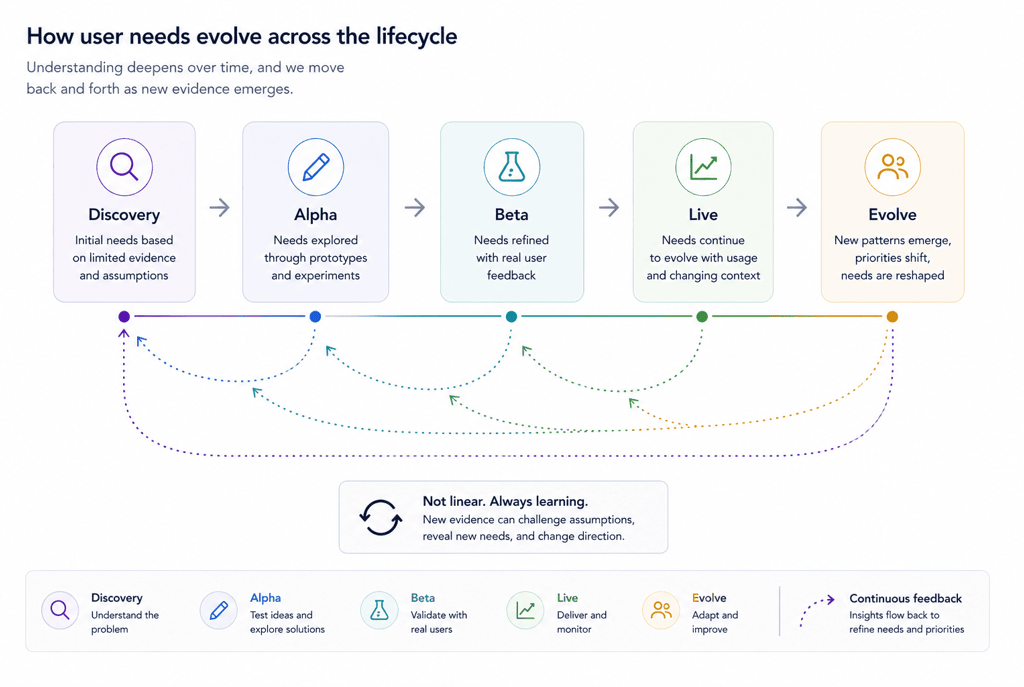
What changes across these stages is the understanding of the problem itself. Needs that seemed clear at the beginning can shift once they’re tested against real systems, policies, and user behaviour. Something that looks like a usability issue may turn out to be a policy constraint. As more evidence comes in, teams need to revisit earlier assumptions, reshape needs, and adjust priorities.
Teams move back and forth between understanding and delivery, responding to new information as it appears. Work done in Beta can trigger new Discovery, and insights from Live can reshape earlier decisions. This overlap reflects how services actually evolve, which is just small part of what service design in government entails, with lifecycle stages acting more as a reference point than a true representation of how work unfolds day to day.
Where user needs lose their influence
U needs can be overridden by stakeholder preferences, especially when decisions are driven by internal priorities or external pressures. They can also be simplified into high-level statements that are easy to agree with but difficult to act on, losing the specificity that made them useful in the first place. Also when teams face delivery pressures, they’re often pushed aside, as teams focus on meeting deadlines rather than fully understanding the problem.
Over time, this changes their usefulness. User needs remain visible in documents, presentations, and artefacts, but become less active in decision-making. Decisions are made, changes are implemented, but the connection back to real behaviour becomes weaker. This drift is rarely intentional and is usually a result of competing pressures and shifting priorities.
This pattern connects to the wider environment services are built in, when dealing with the challenges of designing services in the public sector, as structural constraints, delivery pressure, and organisational dynamics all shape what gets prioritised and what gets left behind.
What it looks like when it works
When user needs are used well, they create a shared reference point across disciplines. Service designers, user researchers, product managers, and developers can align around the same understanding of what matters, even if they approach it from different angles. When decisions are challenged, they’re grounded in evidence, and when priorities shift, there’s a clearer way to assess impact.
When this is working well, it tends to show up in consistent ways:
Decisions are explained in terms of user impact
Teams refer back to specific needs during discussions
Prioritisation is driven by what changes outcomes
Trade-offs are made explicit, with a clear understanding of who is affected
User needs evolve over time as new evidence emerges
Bringing it back to decisions
User needs only matter if they influence what gets built, changed, or removed. Without them, decisions are shaped by what is easiest to deliver, instead of what works for users. The impact of changes can be traced more directly, feeding into how success is measured across the service as part of understanding outcomes more holistically. User needs will make your work more visible by connecting evidence to action and action to outcomes, in a way that holds up even in complex environments.
User needs in government are often built from incomplete and sometimes conflicting signals about how people interact with services. They come from different sources, reflect different perspectives, and often change as more is learned. As services evolve and conditions in the world shift, so do user needs, which means teams should be constantly interpreting, refining, and reapplying them rather than treating them as fixed outputs.
What “user needs” actually mean
User needs are clear, testable statements grounded in evidence which describe what someone is trying to do, the situation they’re in, and the barriers that get in their way. A useful user need is specific enough to act on. For example, instead of saying “users need clear information,” a stronger version could be: users need to know what happens after they submit their application so they’re not left uncertain about next steps or timelines. This level of clarity gives teams something concrete to design and test against and without it, user needs stay at a level of general principles that are easy to agree with, but difficult to apply in real decisions.
Where user needs come from
User needs are built by piecing together different types of evidence that show different views of the service. User research activities like Interviews, observations, and usability testing reveal how people approach a service, what they expect, and where they struggle, but all these only paint a partial picture.
Operational data adds another layer. Call logs, complaints, and drop-off points show where services break, highlighting patterns that don’t appear in smaller research samples. Additionally, frontline staff bring a different kind of insight. Caseworkers and support teams see how rules are interpreted in reality, where people get stuck, and how workarounds emerge under pressure. Bringing these sources together is what makes user needs more reliable. This evidence is rarely held in one place due to the nature of how government services are designed behind the scenes.
Turning research into usable needs
While research produces observations, transcripts, and patterns, teams still have to interpret what matters, what repeats, and what has the most impact. This process involves analysis and prioritisation. There’s a tendency to over-generalise which turns specific insights into vague statements that lose their usefulness. There's also a risk of oversimplifying complex situations just to make them easier to communicate. Both approaches weaken the connection between evidence and decision-making.
Prioritisation is where this becomes practical. Not all needs carry the same weight, and treating them equally usually leads to shallow decisions. Some needs show up frequently but are relatively easy to resolve. Others are less common but have a disproportionate impact, blocking people from completing a service or forcing them into workarounds.
Looking at frequency and severity in isolation doesn’t tell you what matters most. Teams have to consider how needs interact with each other, how they affect different groups of users, and what the downstream consequences are if they’re not addressed. A need that causes a small delay might seem minor, until you see it driving repeat contact or increasing pressure on operational teams. Another need may only affect a smaller group, but if this group is already in a vulnerable situation, the impact is much greater.
This is why context is critical. Prioritisation involves judgement about what will make the biggest difference to how the service works. It also involves being explicit about trade-offs, because focusing on one need often means deprioritising another. Good prioritisation is about understanding which needs, if addressed, will meaningfully change outcomes for both users and the service.
How user needs influence design decisions
User needs, when applied correctly, affect the order of steps, the way information is presented, and how users move between channels. They help teams decide what to include, remove, and simplify. They also provide a way to navigate trade-offs, when teams are deciding between competing priorities, user needs offer a reference point. They help answer questions like:
Does this change actually help someone complete the task?
Does it reduce confusion, or move it somewhere else?
This is how they become part of day-to-day work. This dynamic shows up in multidisciplinary teams, where decisions are shaped by multiple constraints and perspectives rather than a single, linear process.
Navigating tension with policy and constraints
User needs sit alongside policy, systems, or operational limits. As a result, there are many situations where user needs and constraints don’t align. A user may need flexibility, but eligibility rules may be fixed. Or a process may need to be shorter, but verifcation requirements may prevent that..
In such situations, user needs don’t automatically “win.” Instead, they make the impact of decisions visible, showing where friction exists, who is affected, and what the consequences are. This tension sits within a broader pattern explored in the gap between service design and policy design in government, where alignment between intent and experience is continuously worked through and doesn’t always hold.
Designing beyond the “happy path”
Services are often designed around a standard journey that reflects an ideal version of how a service should work. However, real usage is different with instances of people pausing, restarting, switching channels, and dealing with changing circumstances. They might not have all the information required or they may misunderstand a question and these situations are part of normal service use.
Designing for this reality means building in support for recovery that Allows people save their progress, return later, or take alternative routes. It also means recognising that a service that only works under ideal conditions is incomplete. This is very visible when designing for vulnerable and hard-to-reach users. For such groups, the gap between expected and actual behaviour is often the widest and has the most profound impact.
Using user needs across the lifecycle
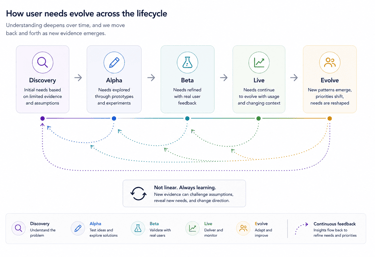
While user needs are often identified early, the first version is usually incomplete and shaped by limited evidence. During Discovery, teams begin to understand what matters, but they’re often working with partial insight and assumptions that haven’t been fully tested. As work moves into Alpha, these needs are explored through prototypes and experiments, which start to reveal what holds up and what doesn’t. By the time a service reaches Beta, needs are refined further based on real usage, and in Live, they continue to evolve as new patterns and behaviours emerge.
Let's chat about your next design project.
Phone
07826 451774
© 2025. All rights reserved.
Social