
How government services are designed behind the scenes
Discover how government services are designed behind the scenes, from understanding user needs to mapping processes and improving service delivery.


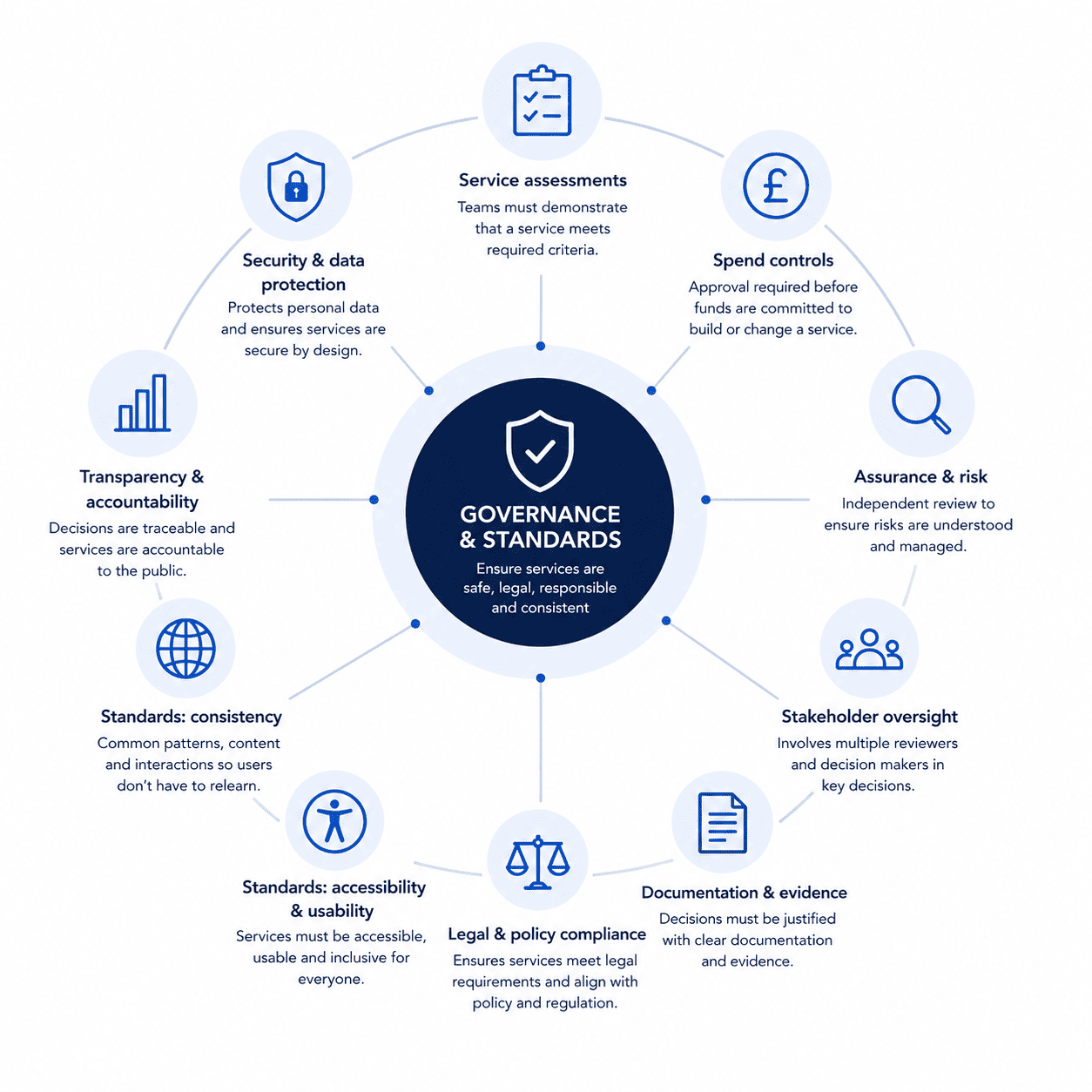
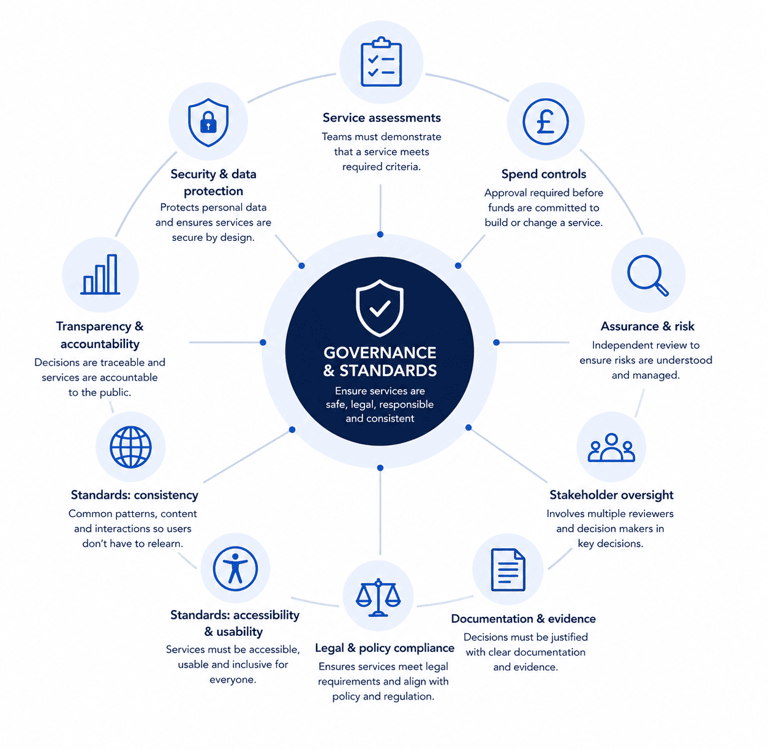
This includes things like service assessments, where teams have to demonstrate that a service meets certain criteria before moving forward, and spend controls, which require approval before money is committed to building or changing a service. Assurance processes sit alongside these, reviewing decisions to make sure risks are understood and managed. Alongside governance, there are standards that guide how services should be designed and delivered, covering areas like accessibility, usability, and consistency so that services work for a wide range of people.
Government services deal with sensitive data, public money, and decisions that can have serious consequences for individuals. Governance helps ensure that services are fair, secure, and accountable, while standards help create a level of consistency so users don’t have to relearn how to interact with each new service. These same mechanisms also shape how work happens day to day by introducing checkpoints that teams have to pass through and documentation to justify decisions. This can slow things down, especially when teams are trying to iterate quickly or respond to new evidence.
Governance becomes part of the design process as teams need to think about how decisions will be assessed, what evidence is required, and how risks are communicated. This influences what gets prioritised, how changes are scoped, and how quickly they can be delivered. The challenge is working within it in a way that still allows for learning and adaptation.
Systems and infrastructure
Behind most government services are critical systems that store data, process transactions, and support core parts of the service. But because they were not designed with current needs in mind, they may not integrate well with newer platforms and they can be difficult to change. As a result, new services are often layered on top of existing infrastructure, connecting digital interfaces to older systems. At the operational level, workarounds are introduced to bridge gaps and over time, the service becomes a combination of old and new components.
This creates a situation where services are patched together rather than fully designed from scratch. Understanding how these connections work is essential when mapping complex government services across departments.
Where things typically break down
Breakdowns tend to happen at the boundaries, because that’s where assumptions from one part of the system meet the realities of another. The gap between policy and delivery is a common example where a rule may be clearly defined in policy terms, but translating it into a process introduces interpretation. Delivery teams have to decide how that rule works, what evidence is required, and how strictly it should be applied. Small differences in interpretation can lead to inconsistent experiences.
Handoffs make these problems more visible when a user moves from one system to another, or from digital to offline support. Context can be lost and decisions made in one part of the service aren’t always visible in another. These transitions rely on assumptions that don’t always hold true when systems were not designed to work together.
Services are often designed around a standard path that assumes users follow a predictable sequence and when that doesn’t happen, gaps show. People with complex circumstances, or changing situations are more likely to fall outside these assumptions. These are the points where the service either adapts or fails. This is why designing services for vulnerable and hard-to-reach users becomes a practical way of testing whether a service works under real conditions rather than ideal ones.
What good looks like behind the scenes
Good service design behind the scenes provides a shared understanding of how the service works, even if ownership is distributed. Teams are aware of how their decisions affect other parts of the service and collaboration happens continuously. User needs, operational data, and system constraints are considered together and this helps teams make better trade-offs and adapt as conditions change, shaping how user needs shape government services in reality. It’s not a perfect solution as constraints still exist, and trade-offs are still necessary but it's a positive step forward.
Looking at the system as a whole
Having clearer understanding of the system explains why a service behave the way it does, why changes take time, and why improving outcomes requires working across boundaries. Without this connection, improvements remain local and fragmented. With service design, teams can start to see how changes affect the service as a whole, and feed this into how success is understood across the system, alongside how to measure success in public sector service design. Ultimately, designing government services required understanding how everything behind the scenes works together to support the users’ experience.
Many government services appear linear with a defined start, middle, and end, giving an impression of a single joined up system working as designed. This representation of one service is typically an assembly of interconnected systems, teams, policies, and processes that have developed over time. Ownership is distributed, decisions are made across different layers of the organisation, and changes move at different speeds depending on constraints. This is one of the reasons why:
services can feel fragmented
improvements are uneven
experience can vary depending on how and where someone interacts with it
Why “behind the scenes” matters
Without understanding what sits behind a service, a confusing step gets treated as a content issue when it’s actually driven by policy or a delay looks like inefficiency when it’s the result of multiple checks happening across systems that don’t talk to each other. When teams focus solely on what’s visible, they optimise individual touchpoints while the overall service becomes harder to use. Changes are made in isolation, decisions are taken without full context, and overall experience fragments further over time. Improving services in this environment means understanding how different parts connect, where decisions are made, and how constraints shape what’s possible. This shift in perspective sits at the centre of what service design in government means.
The layers of a government service
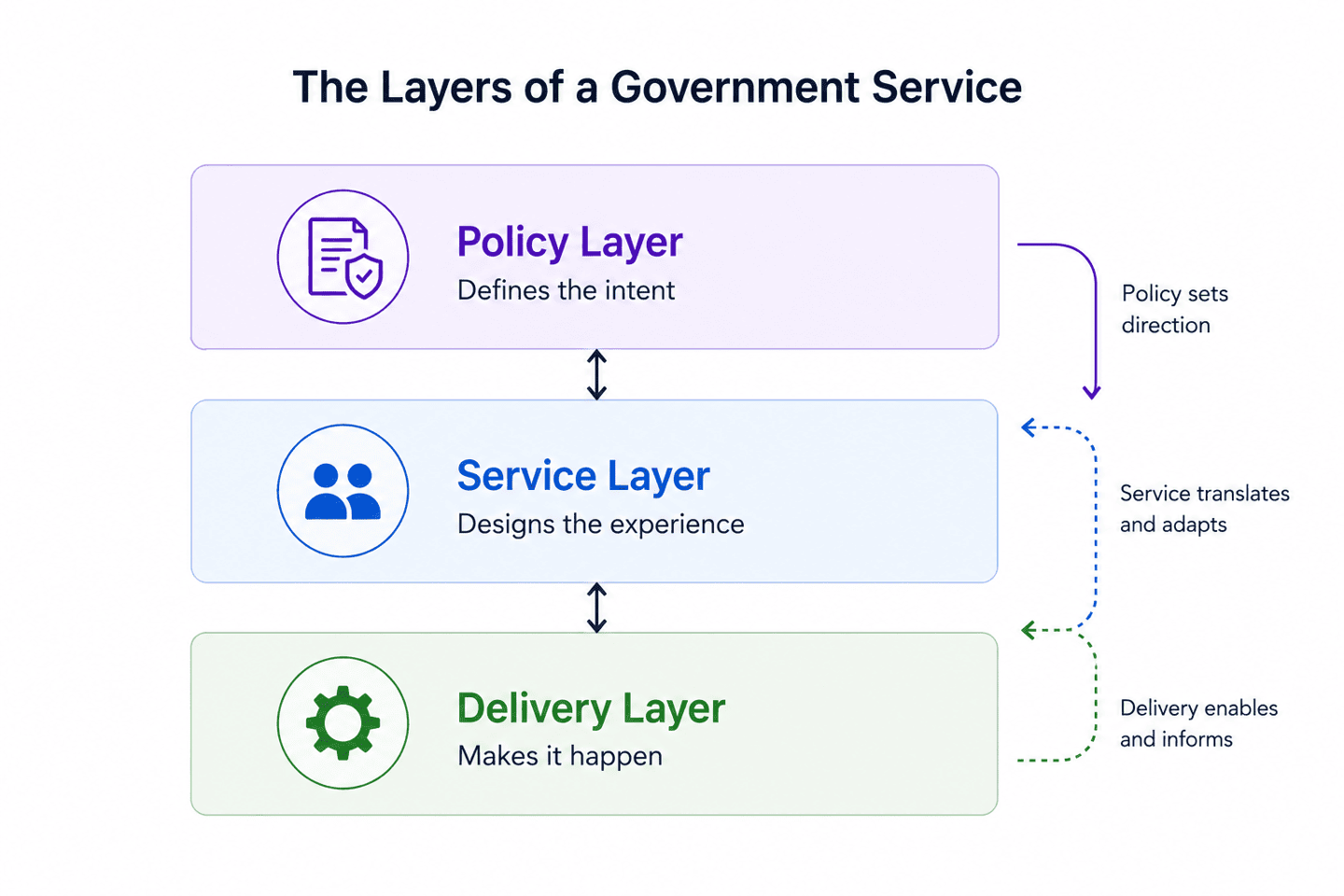
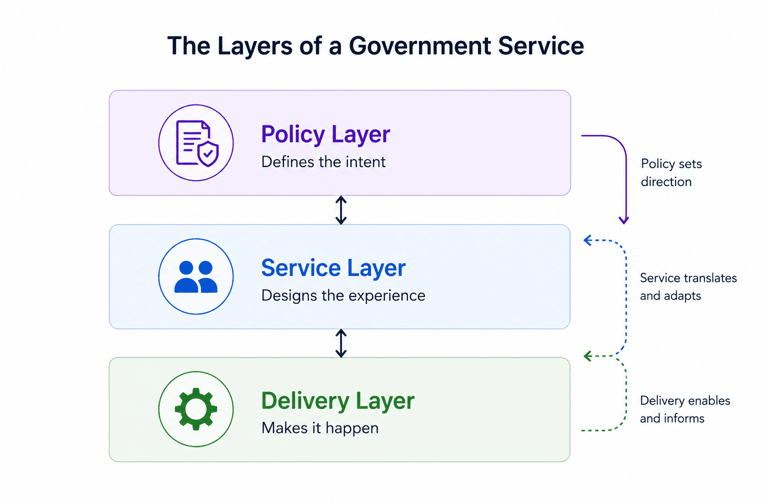
Most government services can be understood across three layers, even if these layers aren’t always visible or explicitly defined.
The policy layer defines intent. It sets eligibility, outlines what needs to happen, and determines the outcomes the service is trying to achieve. This layer is shaped by legislation, political priorities, and risk considerations. It describes how a service should work in principle. The challenge is that policy often assumes consistency and clarity, while real-life situations are rarely that predictable, resulting in the need for more interpretation as delivery gets closer.
The service layer sits between intent and reality. It translates policy into something people can use by shaping journeys, interactions, and the structure of the experience. This includes how users move through a process, what information they’re asked for, how different steps connect, and how the service behaves across channels. Decisions at this level are about making policy workable and clarifying which trade-offs have to be made.
The delivery layer includes the systems that process information, the operational teams that handle cases, the contact centres that provide support, and the infrastructure that keeps everything running. This layer is often where constraints are most visible. Legacy systems, manual processes, and organisational boundaries all shape what can actually be delivered. This is also where small design decisions can have large operational consequences, affecting volume, workload, and cost.
In an ideal setting, these layers work together, with policy defining the rules, service design shaping the experience, and delivery executing it. But often times, policy evolves without always accounting for delivery constraints, systems persist long after the context they were built for has changed, and services are adjusted in response to immediate needs rather than redesigned as a whole. This drift is similar to the tension betwen service design vs policy design in government, with intent and implementation continually needing to be reconciled rather than naturally staying aligned.
Who is involved and why it’s complex
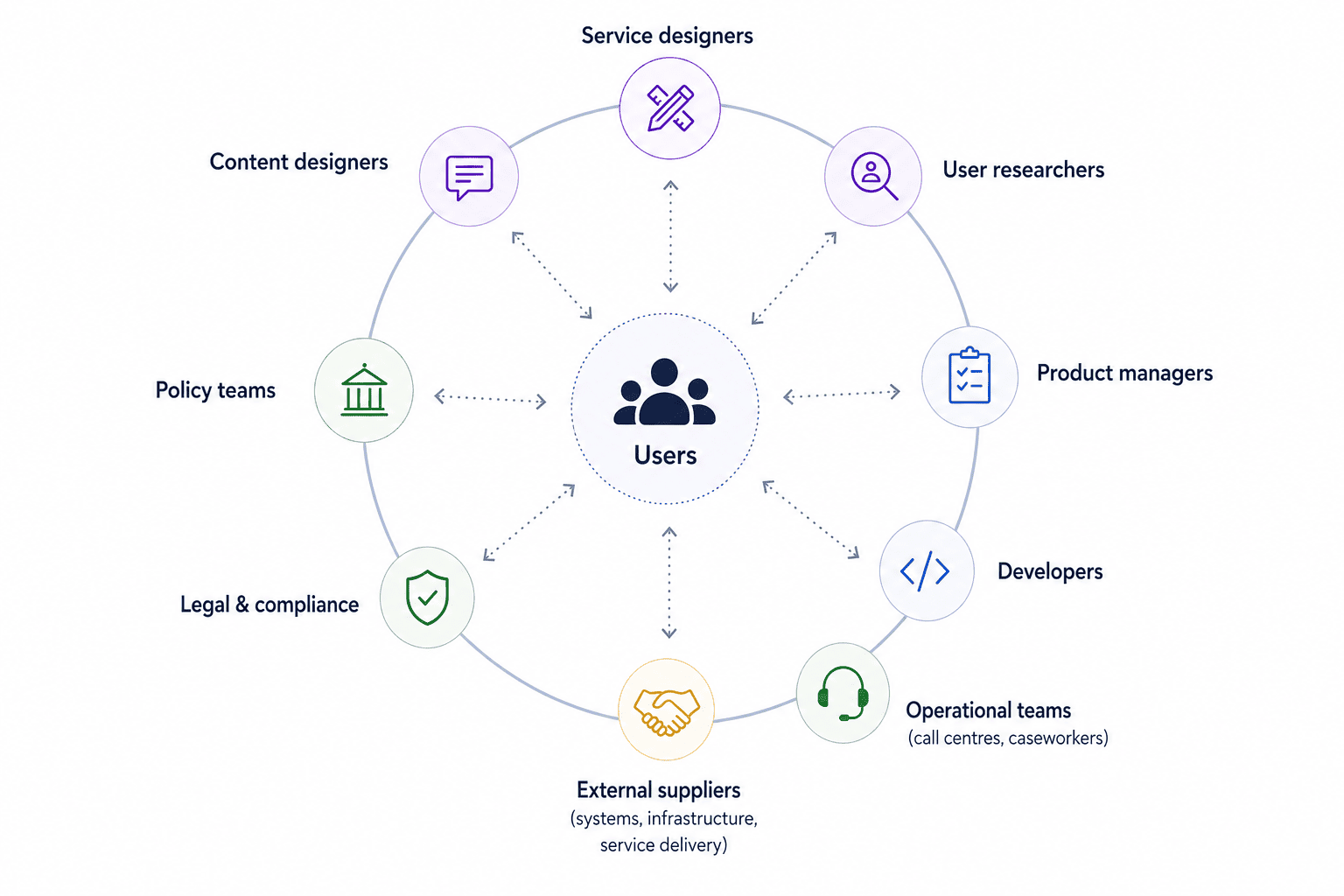
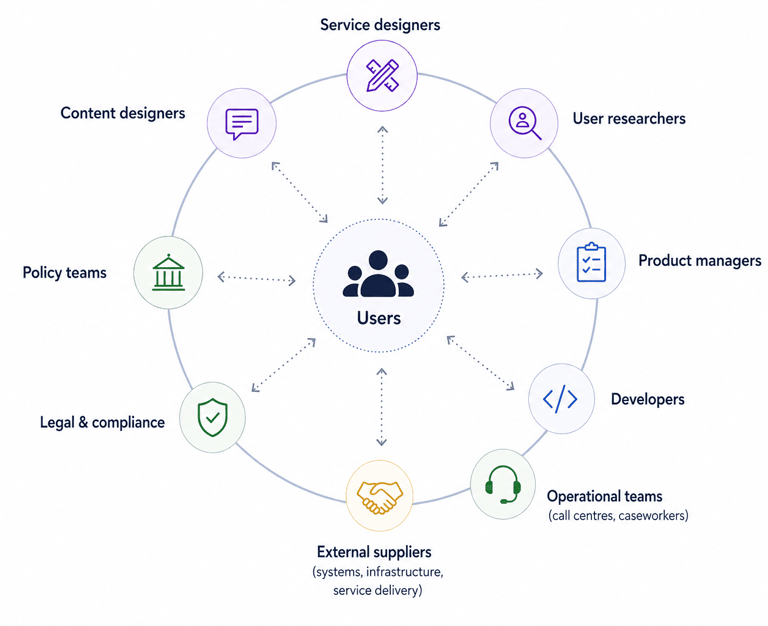
A government service involves various roles that look at the service from different angles.
Service designers focus on how the whole service holds together, looking across journeys, systems, and teams to understand how decisions in one area affect another. User researchers bring evidence into the picture, gathering insight into what people are trying to do, where they struggle, and how they behave in real situations. Product managers are responsible for direction and prioritisation, balancing user needs with delivery constraints, timelines, and organisational goals. Developers translate ideas into something that can be built and maintained while content designers shape how information is communicated, making sure language is clear, usable, and aligned with how people understand the service.
Alongside them, policy teams define the rules that the service operates within, focusing on eligibility, compliance, and ensuring decisions are consistent and defensible. Legal and compliance specialists make sure the service meets statutory requirements and manages risk appropriately, which can introduce additional constraints on how things are designed. Operational teams deal with the service in its most practical form, handling real users, edge cases, and situations that don’t fit the standard path, and often developing workarounds to keep things moving.
External suppliers add another layer, taking responsibility for building and maintaining systems, running infrastructure, or delivering parts of the service under contract. Their involvement can shape how quickly things change, what can be modified, and how knowledge is shared across the service.
Each group understands its own part of the service in detail, but no single team has full visibility of how everything connects. Alignment becomes something that has to be actively maintained through conversation, negotiation, and shared understanding. This way of working is a fundamental part of how service design works inside government teams.
Decision-making behind the scenes
Often times, policy can’t be changed quickly, even when issues become visible in delivery due to being tied with legislation. There's is also technical feasibility that needs to be considered as systems may not support the desired change and even small adjustments can have unintended consequences elsewhere. Budget and timelines add further pressure as funding is often fixed or tied to specific outcomes and delivery commitments. To add to this, decisions are often influenced by concerns around fraud, legal challenge, reputational impact, and operational failure, which can push teams toward safer options.
Decision-making becomes a balancing act weighing what users need against what policy permits, what systems can handle, and what can be delivered within the constraints they’re working under. A change that improves usability may introduce operational complexity, or a policy-aligned approach may still prove difficult for users to understand or complete.
As new evidence emerges, whether from user research, operational data, or live service performance, earlier choices are revisited and constraints shift as well. Policy may evolve, systems may be updated, priorities may change. This creates a cycle where decisions are constantly adjusted.
The role of governance and standards
Governance is the set of checks, approvals, and controls that make sure public services are safe, legal, and responsible.
Let's chat about your next design project.
Phone
07826 451774
© 2025. All rights reserved.
Social