
A problem framing framework for challenging assumptions and driving better decisions
Many teams struggle because they’re not solving the same problem. This often starts with a rush to solutions, especially under pressure to deliver, where direction feels more valuable than understanding. At the same time, different roles interpret the issue through their own lens. Policy sees intent, operations sees constraints, and design sees experience. At a high level it looks like alignment, but once you zoom in, these interpretations don’t fully match. What ties them together are hidden assumptions that rarely get surfaced or challenged, resulting in activities without clarity and progress that feels productive but isn’t always pointing in the right direction.
The role of framing in hypothesis-driven service design
Framing sits within a wider hypothesis driven iterative service design approach, where teams move from assumptions to evidence through cycles of validation, testing, and learning. Before anything can be tested, improved, or delivered, teams need to be aligned on what they’re trying to understand. Without that, hypotheses are built on a shaky foundation and testing becomes disconnected from the real problem.
Framing provides the structure to bring policy intent, operational reality, and user need into one shared view.
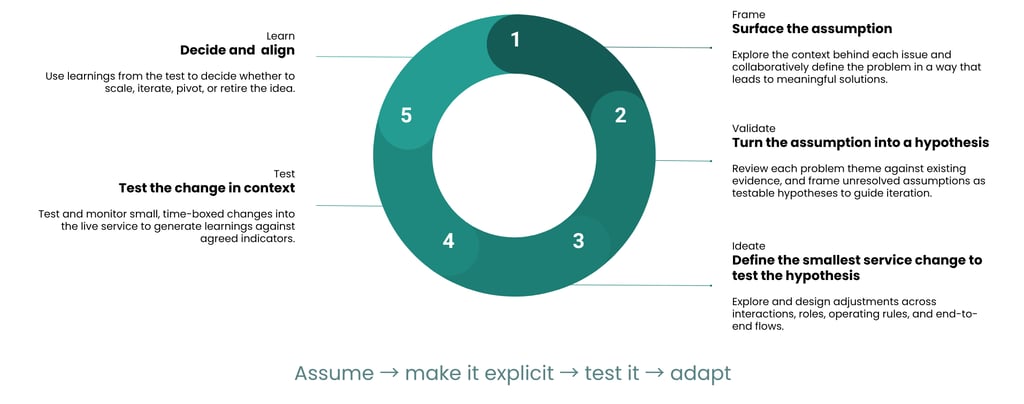
It anchors the rest of the loop by making assumptions visible and turning them into something that can be worked with. If the broader approach is about moving from assumption to evidence then framing is the point where that shift starts taking form.
What good framing needs to achieve
Good framing is about creating clarity where there is ambiguity. It brings different perspectives into one shared understanding and makes uncertainty visible in a way that can be acted on. When done well, it gives teams direction by:
Aligning multiple disciplines: Framing creates a shared understanding across policy, operations, design, delivery, and analysts. It reduces misalignment by ensuring everyone is working from the same definition of the problem.
Surfacing assumptions explicitly: Instead of leaving assumptions buried in conversations or decisions, framing makes them visible by creating a space to question and test them.
Connecting evidence to decision making: It links what is already known with what still needs to be understood which helps teams avoid starting from scratch or duplicating effort.
Creating momentum: Good framing leads directly to action. It produces outputs that inform hypotheses, guide testing, and shape next steps.
A practical problem framing framework for aligning teams and surfacing assumptions
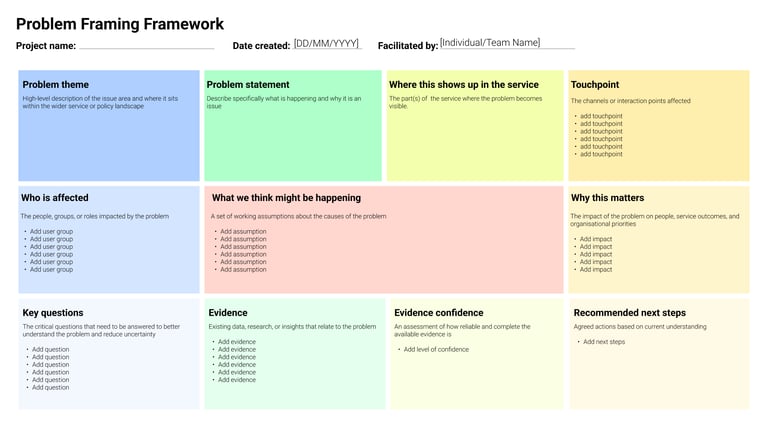
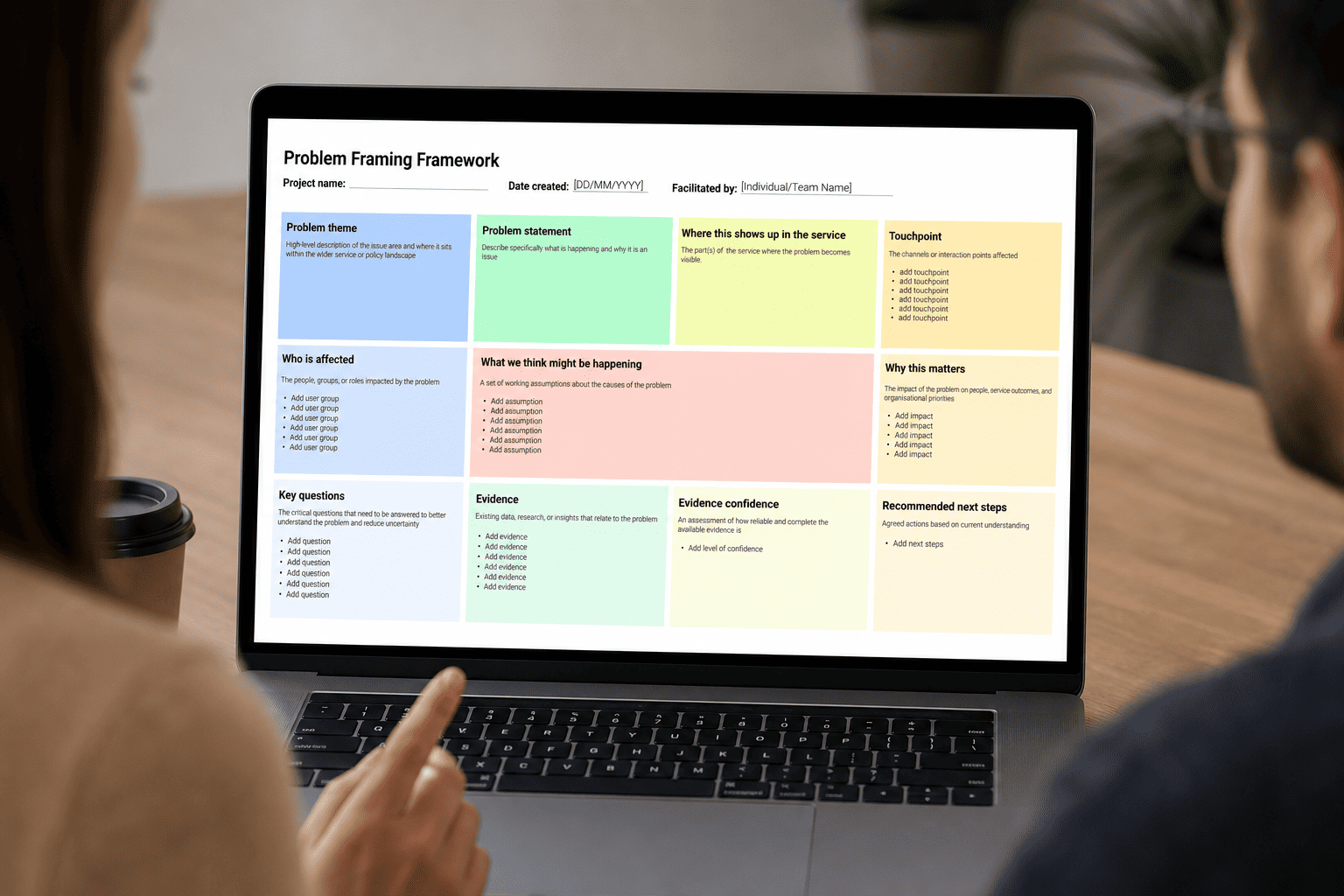
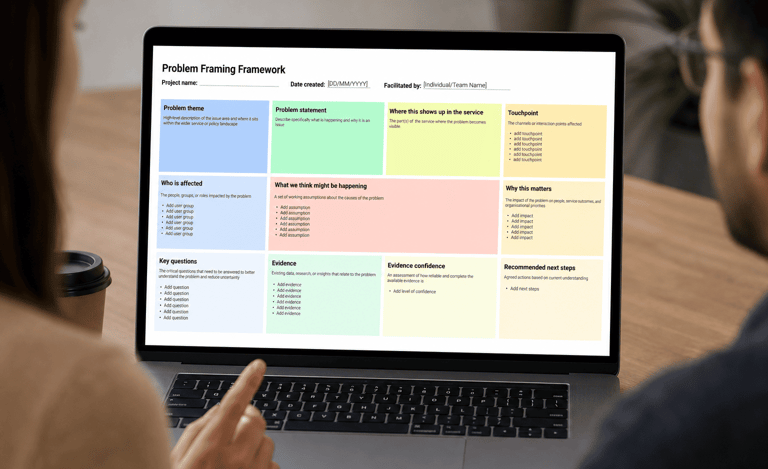
This framework is designed to help teams define problems clearly while making assumptions visible and usable. It prioritises clarity over completeness, ensuring that what is captured can actually be acted on. The structure is deliberate but flexible, allowing teams to adapt it based on context without losing consistency. It is built for collaboration, bringing together different disciplines to contribute their perspective in a way that fits together which is a crucial step towards ensuring the information added is comprehensive and as close to the truth as possible.
How each part of the problem framing framework helps define problems and expose assumptions
Problem theme: Start by anchoring the issue within the wider service or policy landscape. This helps teams understand where the problem sits and why it matters in a broader context. In government settings, this often links back to policy intent or strategic priorities.
Problem statement: Move to a clearer articulation of what is actually happening. This should describe the situation in specific terms, avoiding assumptions about causes at this stage.
Where this shows up in the service: Identify the points in the service where the problem becomes visible. This makes the issue tangible and helps ground discussions in real interactions and processes.
Touchpoints: Document the channels or interaction points involved, such as online services, phone calls, or in-person interactions. This helps identify where changes may need to happen.
Who is affected: Define the people or groups impacted by the problem. This should be everyone interacting with the problem area, including edge cases and vulnerable users.
What we think is happening: This is the core section where assumptions are captured. The goal here is to articulate beliefs without presenting them as facts, allowing them to be validated later.
Why this matters: Connect the problem to outcomes, including user impact, operational efficiency, and policy goals. This helps prioritise what needs attention.
Key questions: Turn these assumptions into questions that guide inquiry. These questions will shape research, analysis, and testing.
Evidence: Capture existing data, research, and insight that relate to the problem. In organisations where analysts sit on a library of past research reports and evaluations, this is where they play a key role.
Evidence confidence: Assess how reliable and complete the evidence is. This helps avoid overconfidence in partial data.
Recommended next steps: Define what should happen next based on current understanding. This could include testing, further research, or immediate changes.
The role of analysts and evidence in this process
Analysts play a critical role in grounding the framing in reality. They bring visibility of existing evidence, including data trends, past research, and ongoing tests. This helps teams understand what is already known and where the gaps are. By maintaining an overview of evidence and activity, analysts prevent duplication of effort and ensure that new work builds on what already exists. This makes the process more efficient and strengthens the quality of decisions being made.
In teams without dedicated analysts, this responsibility often sits across multiple roles. Service designers, user researchers, and product leads may each hold parts of the evidence, but it can be fragmented. Without a clear view, teams risk missing important insights or repeating work that has already been done. This leads to framing more reliant on assumptions instead of evidence. It also means additional effort is needed to bring information together before decisions can be made.
In agency environments, the challenge is often access rather than capability. Agencies may have strong skills in research and analysis, but limited visibility of internal data or ongoing tests. This creates gaps in understanding that need to be addressed through collaboration with client teams. Framing in this context requires more effort to validate assumptions and build a shared evidence base.
In startups, speed often takes priority over structure. Teams may rely heavily on instinct and rapid experimentation, with less formal documentation of evidence. While this can drive quick progress, it increases the risk of repeating mistakes or missing patterns over time.
To adapt this framework, teams need to adjust how evidence is gathered and shared. This may mean creating lightweight evidence logs, assigning ownership of insight, or building simple ways to track tests.
How this framework differs from Theory of Change
This framework may appear similar to a Theory of Change but they serve different purposes and operate at different levels of decision making. A Theory of Change is primarily concerned with outcomes and causality. It maps how activities are expected to lead to outputs, outcomes, and ultimately long-term impact. Also, it is commonly used to support policy development, programme design, business cases, evaluation planning, and benefits realisation. It helps organisations articulate why a particular intervention is expected to create change.
The Problem Framing Framework on the other hand attempts to answer the question - "Do we actually understand the problem we are trying to solve?"
This distinction is important because many service improvement initiatives begin with assumptions around what the problem is. Teams may already have potential solutions, delivery plans, or policy intentions in mind, but have not yet established a shared understanding of the issue itself. The Problem Framing Framework focuses on helping teams align on the problem, identify uncertainty, surface competing interpretations, and understand what evidence exists before deciding what intervention should happen.
This is particularly valuable in public service improvement projects, where services often involve multiple teams, complex operational processes, policy constraints, legacy systems, and diverse user groups. In these environments, disagreements are often about the nature of the problem itself. A useful way to think about the relationship between the two approaches is:
Problem Framing Framework helps teams understand the problem.
Theory of Change helps teams understand how change is expected to happen.
When to use each approach
Use the Problem Framing Framework when:
Improving an existing service
Multiple disciplines have different views of the problem
Assumptions need to be surfaced and tested
Existing evidence is fragmented across teams
There is uncertainty about what is actually happening
Use Theory of Change when:
The problem is already understood
Designing or evaluating a programme or intervention
Mapping outcomes and impacts
Building an evaluation framework
Demonstrating how change is expected to occur over time
In practice, the Problem Framing Framework can be used first to establish a shared understanding of a problem which then provides a stronger foundation for developing a Theory of Change.
How this framework differs from the Double Diamond
The Double Diamond encourages teams to move through cycles of divergence and convergence, first exploring the problem space before defining it, and then exploring solutions before delivering them.
The Problem Framing Framework, on the other hand, addresses a gap that often appears when applying the Double Diamond to service improvement work in existing services. The Double Diamond provides a process that tells teams where they are in the design journey and encourages exploration before decision making. What it does not provide is a structured way to capture, challenge, and organise assumptions across policy, operations, design, delivery, and analysis as teams attempt to define the problem.
In real-world application, many teams move through the Discover and Define phases while still holding different interpretations of what is happening. Research findings, operational insights, stakeholder opinions, and policy objectives are gathered, but assumptions can remain implicit. Teams often leave workshops believing they are aligned when they are actually working from different mental models. The Problem Framing Framework introduces more structure at this point by creating a shared artefact that explicitly captures:
What the problem is
Who is affected
Where it appears in the service
What assumptions are being made
What evidence exists
How confident the team is in that evidence
What questions still need answering
The unique role of the framework
The Double Diamond helps teams navigate the design process.
Theory of Change helps teams understand how interventions create outcomes.
The Problem Framing Framework helps teams create a shared understanding of an existing service problem before either of those activities can be effective. Its unique value lies in turning assumptions into something visible, discussable, and testable. By bringing policy intent, operational reality, user needs, and existing evidence into a single view, it creates a stronger foundation for hypothesis-driven service improvement.
Rather than starting with solutions, outcomes, or delivery plans, it starts with a simpler but often overlooked question:
Do we genuinely agree on what problem we are trying to solve?
A step by step example of using a problem framing framework to define problems and surface assumptions
Let’s take a common UK local authority service: reporting missed bin collections.
Problem theme
“Residents are repeatedly reporting missed waste collections, creating additional workload for council teams and dissatisfaction among residents.”
Problem statement
“A high volume of missed bin reports are being submitted, even in areas where collections have been completed, leading to unnecessary follow-ups.”
Where this shows up in the service
Online reporting forms
Customer service calls
Follow-up operational processes.
Touchpoints
Council website
Phone lines
Internal waste management systems
Who is affected
Residents, particularly those in high-density areas
Council staff handling reports and collections
What we think is happening (assumptions)
Residents are not aware of collection schedules
Bins are being missed due to operational issues
The reporting system is too easy to access without validation
Why this matters
Increased operational cost
Reduced trust in the service
Inefficiencies in waste management
Key questions
Are collections actually being missed or incorrectly reported?
Do residents understand collection schedules?
What triggers a report submission?
Evidence
Data shows a mismatch between reported missed collections and actual operational records.
Evidence confidence
Moderate: data exists but lacks context on user behaviour.
Recommended next steps
Run a small scale test around changes to the reporting flow.
Resulting hypothesis
If residents are shown real-time collection updates before submitting a report, the number of unnecessary reports will decrease.
We will know this to be true when:
There is a measurable reduction in duplicate or unnecessary missed collection reports within the test area over a defined period (e.g. 4–6 weeks)
These improvements are noticed alongside an increase in users viewing collection status information before submitting a report, without corresponding drop in legitimate missed collection reports being raised
How to run an effective problem framing session with multidisciplinary teams
Running a strong framing session starts by creating the right conditions for honest, structured thinking.
Who to include
Policy
Operations
Service designers, user researchers, content designers, and interaction designers (where appropriate)
Analysts or data specialists
Delivery teams
Product managers
How to facilitate
Start with the problem theme to anchor the discussion
Move through each section of the framework systematically
Encourage contribution from all disciplines
Capture assumptions explicitly without validating them yet
Keep discussions grounded in real service context
Common pitfalls to avoid
Dominant voices that strongly promote a single perspective overriding others
Jumping to solutions instead of focusing on understanding the problem
Treating assumptions as facts when evidence is lacking
Overcomplicating the session by trying to capture everything
Lack of follow-through which steers the activity towards documentation instead of a means to inform next steps
How problem framing connects to hypothesis driven service design and iteration
Framing outputs feed directly into hypothesis creation by turning assumptions into structured, testable statements. Teams should define what they think is happening and what they expect to see if that assumption is true. These hypotheses will go on to inform design. Because the problem has been clearly defined, teams can design targeted interventions that test specific assumptions.
The results of these experiments or tests lead to service changes. Whether scaling, iterating, or pivoting, decisions will be based on what has been learned rather than what was initially assumed. This is where the wider hypothesis-driven iterative service improvement comes into play, moving from framing into validation, testing, and learning.
Why problem framing helps reduce exclusion and leads to better service outcomes
When assumptions are surfaced early, teams are more likely to identify where services may not work for certain groups. This shifts exclusion from something that is discovered later to something that can be actively designed in consideration of. It also ensures that decisions are grounded in real understanding rather than partial views or dominant perspectives. More importantly, it moves framing beyond a workshop activity into a decision-making tool. When used consistently, it improves how we deliver services that work in reality for the people who rely on them.
Let's chat about your next design project.
Phone
kolawale.design@gmail.com
07826 451774
© 2025. All rights reserved.
Social