
Overcoming implementation challenges in turning service design concepts into reality

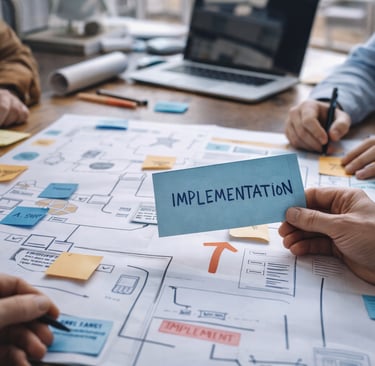
Implementing service design concepts is crucial in today's competitive business landscape. By placing the user at the centre of service development, organisations can better understand and meet customer needs, ultimately leading to increased customer satisfaction and loyalty. Additionally, efficient service design can reduce operational costs, streamline processes, and foster cross-functional collaboration. Embracing service design concepts is not just a choice but a necessity for organisations looking to stay relevant and thrive in an ever-evolving marketplace.
In the realm of service design, there often exists a notable chasm between innovative ideas and their successful execution. Many promising concepts fail to translate into real-world, impactful services. This gap can stem from a variety of challenges, including organisational resistance to change, lack of resources, and difficulties in aligning cross-functional teams. Understanding and overcoming this gap is essential for turning service design concepts into reality and unlocking their full potential.
Common implementation challenges
Resistance to change: Many employees and stakeholders are resistant to adopting new processes or methodologies, fearing disruptions or uncertainty.
Lack of cross-functional collaboration: Siloed departments and teams can hinder the holistic approach needed to design and deliver integrated services.
Resource constraints: Limited budgets, manpower, or time can hinder the execution of comprehensive service design projects.
Scalability issues: What works well on a small scale may not necessarily translate seamlessly to a larger operation.
Strategies for overcoming implementation challenges
Building a culture of innovation: Building a culture of innovation encourages employees to actively participate in the design and improvement of services, fostering a proactive approach to change. This culture values experimentation, learning from failures, and embracing new ideas, which can significantly enhance the implementation of service design concepts.
Creating cross-functional teams: These teams bring together members from various departments, fostering a more comprehensive and holistic approach to service design. Collaboration across functions ensures that different perspectives and expertise are considered, addressing issues that may arise from departmental silos.
Allocating resources wisely: Organisations should prioritise the allocation of budget, time, and resources to the most critical aspects of the service design process. By focusing on high-impact areas, they can maximise the effectiveness of their resources.
Scalable solutions for service design: Organisations should design services with the ability to adapt and grow with demand. This might involve optimising processes, utilising technology, and establishing clear guidelines for scaling up.
Utilising technology for service design implementation
Tools like journey mapping software, prototyping and wireframing tools, and customer feedback platforms help teams visualise, refine, and evaluate service concepts. Collaboration software and project management tools facilitate cross-functional teamwork and project tracking. Customer relationship management (CRM) systems provide data for user research and feedback analysis. Utilising these tools and software can significantly enhance the service design process, making it more efficient and outcome-driven.
Incorporating technology successfully in service design implementation also requires adhering to best practices.
Start by identifying the specific technological needs of your service design project and select tools that align with objectives.
Prioritise user-friendly software and ensure that team members receive access and adequate training (if needed).
Regularly assess the effectiveness of technology integration and be open to making adjustments based on feedback and evolving needs.
Maintain data privacy and security, especially in customer-centric design.
By following these best practices, organisations can harness technology to enhance service design implementation while minimising potential pitfalls.
The future of service design implementation
Emerging trends suggest a growing emphasis on sustainability, inclusivity, and ethical considerations in service design. Artificial intelligence and automation are expected to play larger roles in delivering personalised and efficient services. Data will continue to inform design decisions and enhance customer experiences. As digital ecosystems evolve, the integration of emerging technologies like augmented reality and blockchain may redefine how services are designed and delivered.
AI and automation are already playing a more significant role in the evolution of service design implementation. AI-powered support systems and virtual assistants can enhance customer interactions, providing instant support and personalisation. Opportunities to embed automation streamlines routine processes, reducing operational costs and minimising errors. Machine learning algorithms can analyse vast amounts of data to uncover insights for better service design. As AI and automation continue to advance, their role in service design will become increasingly central, offering more efficient and customer-centric solutions and organisations that leverage these technologies will have a competitive edge in delivering exceptional services.
Ethical considerations in service design
Designers must prioritise user privacy, data security, and informed consent, especially in a digital environment. They should strive for inclusivity, ensuring that services are accessible to diverse populations. Additionally, ethical considerations extend to the impact of services on society and the environment, demanding a commitment to sustainability and social responsibility. By embedding ethical principles into service design, organisations can build trust with customers, avoid potential controversies, and contribute to a more responsible and sustainable future.
In conclusion, the journey from service design concepts to reality can be challenging, but it is worth the effort. Overcoming resistance to change, fostering cross-functional collaboration, wise resource allocation, scalable solutions, and the effective use of technology are key to success. Embracing emerging trends, including AI and ethical considerations, paves the way for future-proof services. By persistently addressing these challenges and embracing innovative strategies, organisations can unlock the transformative power of service design, delivering exceptional experiences and thriving in a dynamic business landscape.
Let's chat about your next design project.
Phone
kolawale.design@gmail.com
07826 451774
© 2025. All rights reserved.
Social