
Are we using AI to document work rather than transform it?
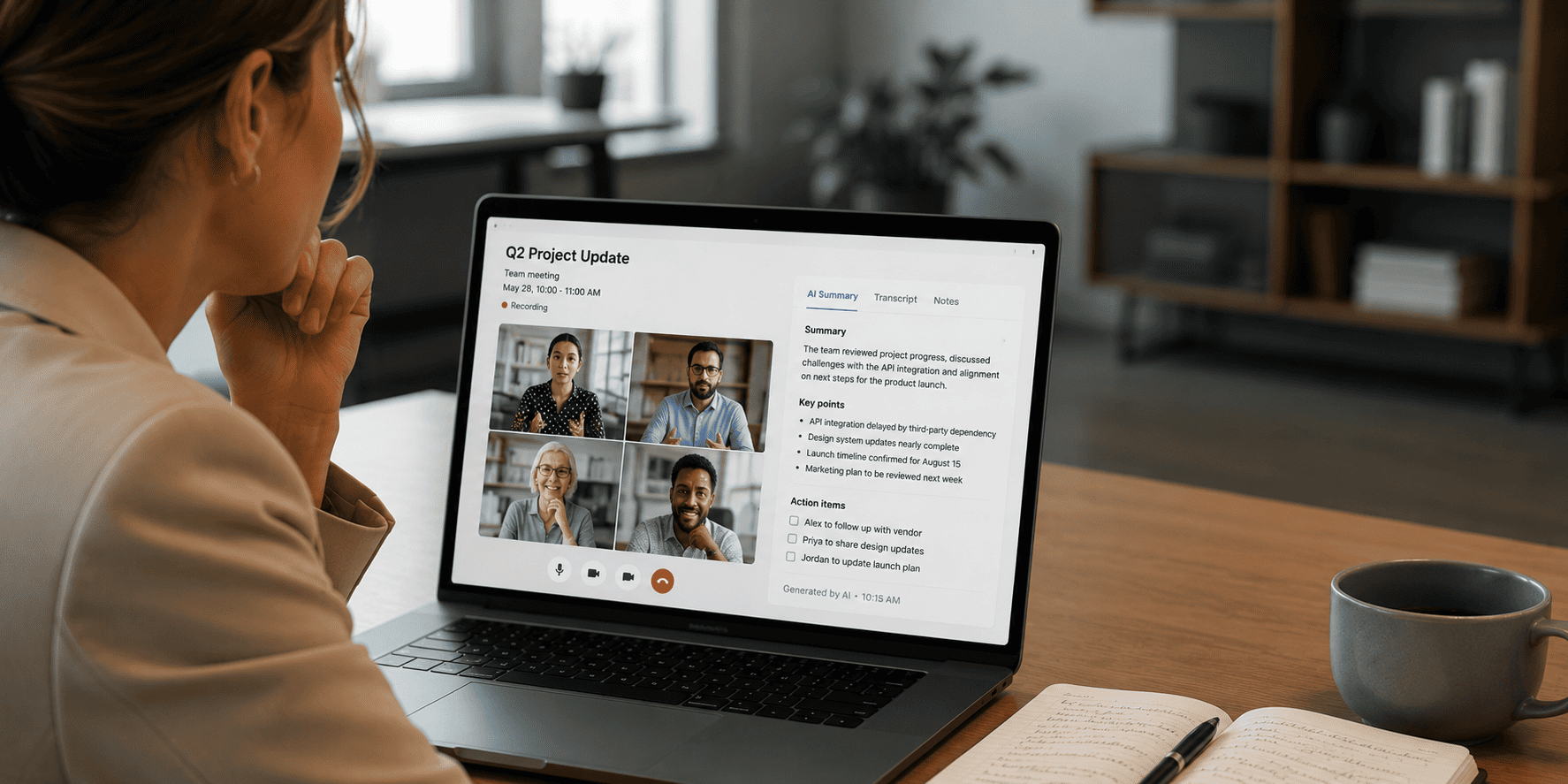
Over the past year, I've noticed a pattern in the way organisations are adopting AI. Almost every conversation seems to land on the same use cases, meeting summaries, transcription, document synthesis, action lists, etc.
None of these are bad applications as they save time, reduce administrative burden, and free people from repetitive tasks that add little value. If you've ever spent an afternoon writing up workshop notes or trying to remember who agreed to what in a project meeting, you'll understand why these capabilities have been adopted so quickly.
But I can't help wondering whether we've become comfortable with where we've chosen to apply it. It feels as though many organisations have embraced AI as a better documentation tool rather than seeing it as an opportunity to fundamentally rethink how services operate.
As someone working in service design, I personally find this fascinating because service design has never really been about documenting the current state. Oftentimes, it's about challenging assumptions, redesigning systems and creating better outcomes for people. So the question I keep coming back to is this:
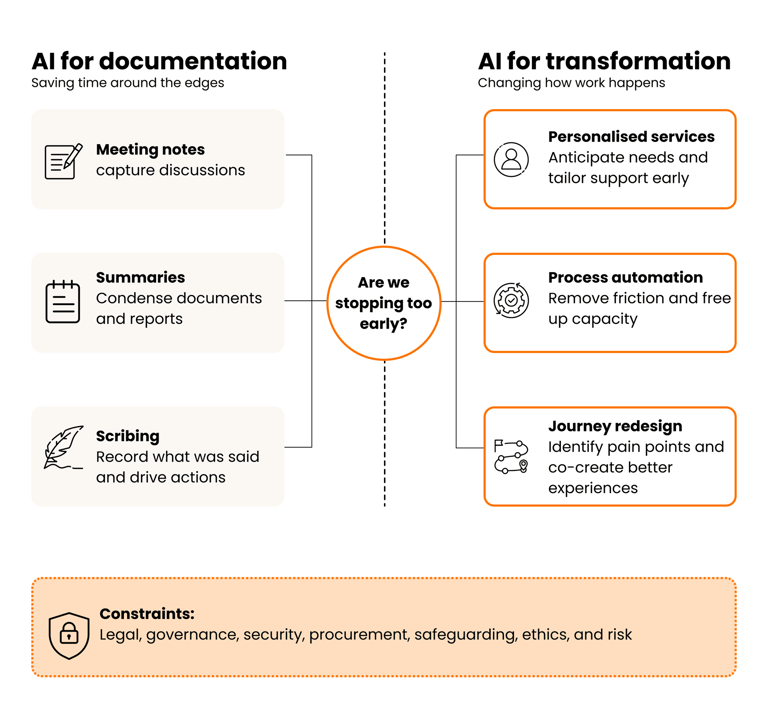
Are we stopping too early?
AI's first wave has focused on productivity
The first generation of enterprise AI adoption makes perfect sense considering organisations naturally gravitate towards low-risk, high-value opportunities. Summarising meetings saves hours every week, generating first drafts speeds up content creation, searching across policies helps people find information faster, and automating note taking allows people to be more present in conversations.
With these, the return on investment is easy to demonstrate and the implementation effort is comparatively low. Also, these use cases don't fundamentally change how organisations operate. As a result, these applications of AI have become the dominant narrative. But productivity improvements and transformation aren't the same thing.
Efficiency isn't transformation
One of the traps organisations often fall into is assuming that making an existing process faster automatically makes it better even though history tells us otherwise. Digitising paper forms didn't transform services, It simply created digital forms. Moving meetings online didn't redesign collaboration, It recreated physical meetings in virtual spaces. This same principle applies to AI.
If we use AI to produce meeting notes faster, we've improved one activity or if we use AI to eliminate unnecessary meetings altogether, we've redesigned the system. These are fundamentally different outcomes. Service designers spend a lot of time distinguishing between improving touchpoints and improving services.
A touchpoint might be a form, a call, a website or a meeting. A service is the collection of interactions, processes, technology, policy and people that work together to achieve an outcome. Improving individual touchpoints matters but redesigning the service matters more.
Where service design changes the conversation
One of the strengths of service design is that it encourages us to zoom out.
Instead of asking:
"How can AI summarise this meeting?"
We can ask:
"Why is this meeting necessary in the first place?"
Instead of asking:
"How can AI draft this document?"
We can ask:
"Why does this document exist?"
Instead of asking:
"How can AI help staff process applications faster?"
We can ask:
"What causes applications to become complex in the first place?"
These questions move us away from optimisation and towards redesign which is where AI becomes much more interesting.
Imagine applying AI to the whole system
Imagine a housing service. Today's AI implementation could automatically summarise case notes after every customer interaction. That's useful.
Tomorrow's implementation might identify emerging risks across hundreds of cases before they escalate, highlight policy inconsistencies that create avoidable demand, suggest where multiple teams unknowingly duplicate work, or identify customers likely to require additional support before they reach crisis point. Now AI isn't is improving decision making.
The same applies across healthcare, local government, financial services, education and countless other sectors. The opportunity is helping organisations see patterns that humans struggle to detect because the information exists across multiple systems, teams and processes. This is a much bigger proposition.
Better decisions over more documents
One area I think deserves much more attention is decision support. Many public and private organisations make thousands of operational decisions every day. Some are routine while some are highly complex.
AI has enormous potential to surface relevant evidence, highlight similar cases, identify risks and present options that improve the quality of human judgement. There's an important distinction between automation and augmentation.
The most exciting applications may be the ones where it enables people to make faster, more informed and more consistent decisions. This is relevant in service design, where decisions often balance policy, operational constraints and human need.
The barriers are real
Although it's easy to talk about possibility, the reality inside large organisations is considerably more complicated. AI adoption doesn't happen in a vacuum. Every implementation has to navigate governance, procurement, security, legal requirements, safeguarding, ethics, information management and regulatory compliance. In sectors handling sensitive personal information, these considerations aren't optional.
Public trust is hard to win and easy to lose. Responsible AI implementation requires organisations to move carefully and sometimes that caution can appear frustratingly slow. But often it's entirely justified. The challenge is finding ways to innovate responsibly within them which iis a much harder design problem.
The innovation gap
What concerns me isn't that organisations are cautious but that caution can sometimes shape ambition. When every discussion starts with identifying the safest possible AI use case, we risk overlooking the most valuable opportunities.
Summarisation becomes the default, while everything else gets pushed into a distant future, and over time, this creates an innovation gap which leads to organisational thinking evolving much more slowly. Eventually this gap becomes less about technical capability and more about imagination.
Service designers have a role to play
This is where I think service designers can make a meaningful contribution.
One of our key roles has always been to understand people, systems and organisational behaviour. We help organisations define the right problems before jumping to solutions and this mindset feels increasingly important as AI becomes embedded into everyday work.
Rather than asking:
"What AI tool should we buy?"
We should ask:
"What service problem are we trying to solve?"
Rather than asking:
"How can AI make this task quicker?"
We should ask:
"What outcome are we actually trying to improve?"
These kinds of conversations naturally lead towards more transformational opportunities because they begin with user needs.
Designing with AI, not around it
Historically, digital transformation projects have treated technology as something added into existing services.
Design the process.
Build the technology.
Train users.
Repeat.
AI challenges this model.
Its capabilities are evolving so quickly that it increasingly becomes part of the design process itself. Instead of asking where AI fits into a service, perhaps we should ask how services should be designed knowing AI now exists. This is a very different conversation as it's more about reimagining operating models.
What maturity could look like
Perhaps AI maturity shouldn’t be measured by something much simpler like:
Are people making better decisions?
Are services becoming easier to use?
Are staff spending more time solving meaningful problems?
Are customers experiencing fewer unnecessary interactions?
Are systems becoming simpler rather than more complicated?
These feel like better indicators of progress because ultimately, technology isn't the outcome. Better services are.
Looking ahead
I recognise that we're still early in this journey and most organisations are understandably focused on building confidence, developing governance and learning where AI fits within existing ways of working. But I also think it's worth asking bigger questions before today's use cases become tomorrow's limitations.
The next phase of AI adoption should help us redesign services, improve decision making, reduce unnecessary complexity and create better outcomes for the people who rely on them.
For service designers, that's an exciting prospect because it gives us another way to challenge assumptions, rethink systems and ask the kinds of questions that good design has always asked.
Let's chat about your next design project.
Phone
07826 451774
© 2025. All rights reserved.
Social